My Approach to AI Assisted Writing
AI Assisted Writing
First off, I understand that this is going to trigger some people, but I use AI (very specifically Anthropic’s Claude Code Opus 4.5) in my writing endeavors.
Now this apparently requires some clarification as using “AI” in the same sentence as “writing” causes some people’s heads to explode because of an assumption all I’m doing is entering a prompt and getting book. This is far from the case.
Proof is In The Pudding
Let’s start with cold hard artifacts and truth. My Book is available on Amazon. I wrote the original 80,000 word draft in 4 days. Yeah. Let that sink in.
Stephen King in his best flow state was notorious for saying he would write 2,000 words a day. Now, I’ll be the first to say that the quality of his work is probably better, but not because of the tooling. What he’s got is a vast amount of experience that I don’t have yet.
The right action beat. The wright phrasing. The appropriate pauses. They’re all muscle memory and instinctual for someone as prolific as King. I’m learning them for sure, as I had extensive feedback from my editor.
Was my first draft perfect? No. Was it ready to go? No, but it had momentum and so much so that I was finally able to strike “publish a book” off of my bucket list.
I realized the hard way that over thinking your manuscript is what keeps you from really making progress. Or maybe that’s just me. I’m a special kind of broken. But it’s a lot easier to clean up something when a skeleton is in place than trying to perfectly imagine it before touching a key.
So I take the approach of letting it all flow first and then reshaping it like clay in the hands of an amateur. It may take more work and it may be messy but anyone can get it to the right state. We know when we are satisfied with our own work, after all.
The General Flow
My general process is a combination of CLAUDE.md instructions at the top level and src/en which is where I keep my chapter / front matter content and the following flow:
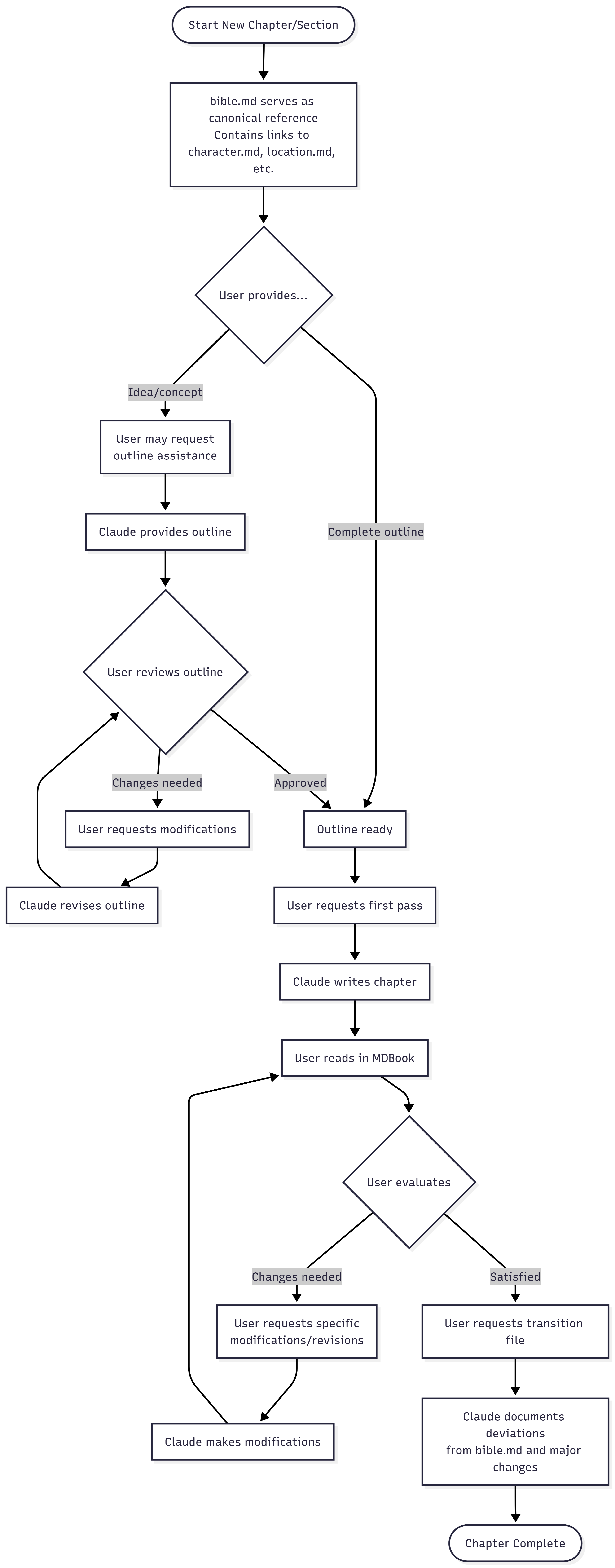
Basically we use a central bible file (bible.md) to store the core contextual components of the book. It MAY not have all the content in it as we can link to other files. When I started writing the Chuin Cascade, I took an approach of having a /characters directory that the bible links to in order to keep the bible from being unwieldy and large.
Basically I come up with an outline or soundboard one with Claude to get an idea. We come up with a plan based on that outline and I let Claude write that content out.
!!!!!BUT ERMAGHERD CLAUDE WRYTEZ UR BOOKZ!
Yeah, in a sense. My characters have speech profiles, behavior patterns both dictated and not dictated. If it writes a bunch of garbage it’s my job to clean it up. Writing good content is not the same as just writing content.
The easiest way I’ve been able to classify it is using Claude as a ghost writer. Same process as a human ghost writer, essentially. It’s just getting content on paper and the approval process happens in seconds not weeks. And surprise, just like any good ghost writer (or any delegated task) the quality of your results depends on the clarity of your instructions.
Then once it produces content, I would read that live with mdbook, ask for changes, discuss potential impacts, have it analyze previous chapters if I feel like there’s an inconsistency and when I say it’s good to go, the chapter is good.
Fuzzy Hats
Another big thing to keep in mind is that your AI assistant is not just relegated to writing copy for you. I used it to build an automatic pipeline for Gitlab so that anytime I created a tag it would create a pre-formatted EPUB file.
Think of that. The entire formatting phase of your process automated away because Claude has more expertise in that space than you do. I have extensive experience in this field, with years in software development, infrastructure, and automation. You might not, but Claude, chatGPT, Gemini etc can do that work for you.
Once you’ve written the book if you don’t have an idea of what to do, AI is great for that as well. I had an entire KDP plan before the book was ready for publishing.
Remember I talked about using mdbook to read the content? Don’t know how? No biggie. Just ask Claude:
Can you help me build a
docker-compose.ymlfile that will render thesrc/encontent as it changes? Ask me anything you need clarification on
It’ll be done and even probably offer to start the services for you before you can realize what happened.
Gatekeeping
Now, I want to talk about something I find odd about this space. Why are people so panicked about AI being used for writing? Amazon asked some interesting questions (none of which fit 60% or greater to my use case) as did booksirens.
There was literally a trigger warning on booksirens about AI. Now I’m super transparent about it. I have an entire section in my copyright page on the book about what roles Claude served, but it’s evident that most people frown upon AI being near creative writing.
I don’t get why though. It’s a tool just like anything else. I know what I want to write, and I know how I want it to feel. If the tedium of me having to spend the time typing the words out keeps me from doing it, then AI reduces the friction enough for me to finally get the story out.
It’s also practically no different from actual ghost writer engagements. AI just doesn’t get tired or annoyed.